Great Expectations
Governments, international agencies, and foundations spend heavily on sending citizens of developing countries to study in the West, treating a foreign degree as a quiet tool for building democracy back home. The United Nations has made the ambition official — Sustainable Development Goal 4.B commits to expanding these opportunities significantly by 2030. But the assumption behind all that spending has never been rigorously tested.

What this project sets out to do
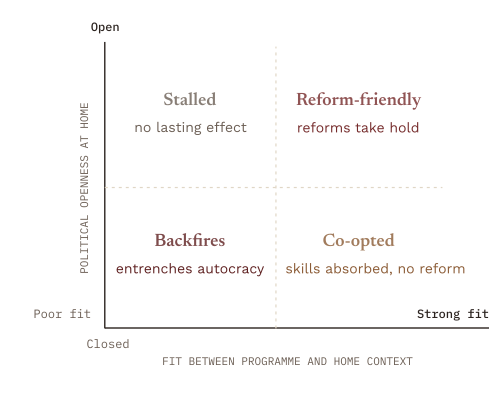
Western-educated citizens don't follow a single script. Some return home and become the reformers who push their countries toward democracy. Others become the reactionary leaders who entrench authoritarian rule. The same pipeline produces both — which suggests the real story isn't about Western education in general, but about which trainees, which programmes, and which political conditions make the difference. That distinction is still poorly understood.
Beyond optimism and suspicion
This project moves past the two camps that usually dominate the debate — the optimists who treat Western education as an automatic democratizing force, and the critics who dismiss it as Western imposition. In their place, it builds a framework for identifying exactly when Western education helps democracy take hold in developing countries, and when it backfires.
Trainees over time
A longitudinal survey follows Western trainees and comparable peers from several developing countries, tracking how political attitudes shift.
Impact in power
Comparative historical analysis examines the influence of Western-educated citizens once they return home and rise into public life.
Western blind spots
A survey experiment probes the biases of the West-based stakeholders who design, select for, and fund these programmes.
A high-stakes moment for both sides
Democracy is backsliding globally, populism is resurging, and large-scale democracy-promotion efforts have a modest track record at best. At the same time, higher education keeps internationalizing, and the EU and UN have both formally committed to advancing democracy, accountability, and human rights worldwide. Separating genuine democratic potential from both Western-centric optimism and reflexive anti-Westernism matters more now than it has in years.

Hosted and funded by

Leiden University
Founded in 1575, Leiden University is the oldest university in the Netherlands and one of Europe's leading research universities, with seven faculties and more than fifty subject departments. The project is based in the Faculty of Governance and Global Affairs, located in The Hague, which studies governance, politics, law, sociology, and economics through an interdisciplinary lens.

Dutch Research Council (NWO)
NWO is the national research funding body of the Netherlands, distributing roughly €1.3 billion annually to support scientific research at Dutch universities and institutes. This project is funded through NWO's Talent Programme Vidi grant, which supports experienced researchers in establishing their own independent research line.